France and Germany, which back a softer 2035 target, bought over half of Europe's electric cars in October
E-Mobility Europe's October bulletin shows 295,252 electric cars registered across 18 markets, up 61%. Germany and France made up more than half, while Paris and Berlin back a weaker 2035 car CO2 target.
Key facts
- Battery electric car registrations in October were 295,252 across the 18 European markets tracked by E-Mobility Europe and New AutoMotive, up 61% on a year earlier, with a 32.1% share.
- Germany (94,069) and France (61,958) together made up more than half of the total. The bulletin says both countries have backed a 90% CO2 target for 2035 without offsetting the remaining 10%.
- The full European Parliament is expected to vote in December and EU governments must still agree. Until then the existing 100% target for 2035 stays in place.
The two countries leading Europe’s push to soften the 2035 car CO2 target are also where most of Europe’s electric cars were registered last month. According to the October bulletin from E-Mobility Europe and New AutoMotive, Germany registered 94,069 new battery electric cars in October and France 61,958. Together that is 156,027 of the 295,252 cars registered across the 18 markets the bulletin tracks, or about 53%, a share we calculated from its table. The bulletin itself says the two countries accounted for more than half.
The numbers behind the headline
The 295,252 registrations are 61% more than in October 2025, and battery electric cars took a 32.1% share of new registrations in those markets. For a general account of the month, including the country table, see our earlier report on the bulletin. This article looks at what the data means for the 2035 debate.
Reuters reports that the data came from E-Mobility Europe, New AutoMotive and Fier Automotive, and cites government purchase subsidies, high oil prices and more affordable models as reasons for the jump. Its figures for the two big markets match the bulletin’s:
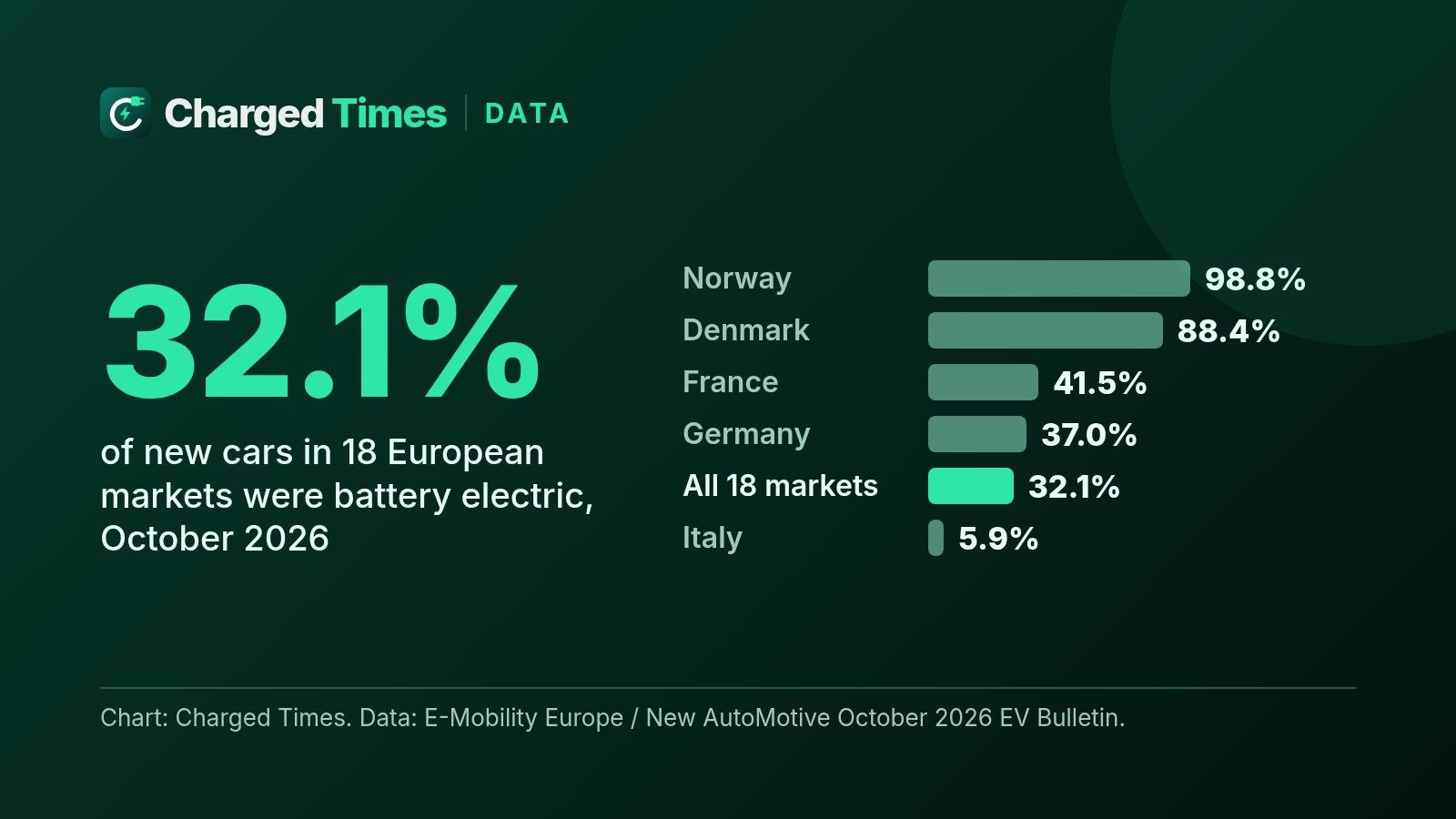
- France: a 41.5% share, with 61,958 registrations.
- Germany: a 37% share, with 94,069 registrations.
- Norway: 98.8%, the highest in Europe. Reuters lists Denmark (88.4%), Finland (59.9%) and Sweden (51.1%) next.
- Lowest shares: Italy at 5.9%, Poland at 6.2% and Czechia at 9.3%.
The 2035 debate
The bulletin says that on 4 November the European Parliament’s Environment Committee voted 48 to 30 to lower the 2035 target for new cars to an 87.5% CO2 reduction, which rises to 95% with credits for EU-made low-carbon steel. It adds that France and Germany have backed a 90% target without offsetting the remaining 10%. We have not independently checked the two governments’ positions, which are as the bulletin states them. We covered the committee vote in our report on it.
The bulletin says the full Parliament is expected to vote in December, and EU governments in the Council must still agree. Until then, the existing 100% target remains in place. Reuters says the data came “amid discussions in Brussels to soften EU car emissions targets for 2035”.
E-Mobility Europe is a trade association for the e-mobility industry. Its secretary general, Chris Heron, said in the bulletin that “some countries are pushing to weaken Europe’s 2035 targets, despite booming electric car sales” and called the situation a contradiction. That is an advocacy view, not a neutral finding, and the bulletin does not say how the registrations relate to the CO2 rule.
Where the figures differ
- Year-to-date total. The bulletin gives 2,295,791 battery electric cars so far this year. Reuters says 2.33 million, up 40.7% on the same period of 2025. The bulletin’s own growth figures are not consistent: its table gives 38.3% and its text says 41%. We have not been able to reconcile these, so we are not giving a single year-to-date growth rate.
- October growth. The bulletin’s table gives 60.9%, and its text says 61%. Reuters says “more than 60%”.
- Scope. All of these figures cover 18 markets that the bulletin says represent about 90% of the combined EU and EFTA market. They are not EU-wide totals and can differ from the car industry association ACEA’s official figures.
The UK is a separate market and is not in the bulletin. Our report on the UK’s October registrations covers the SMMT figures.
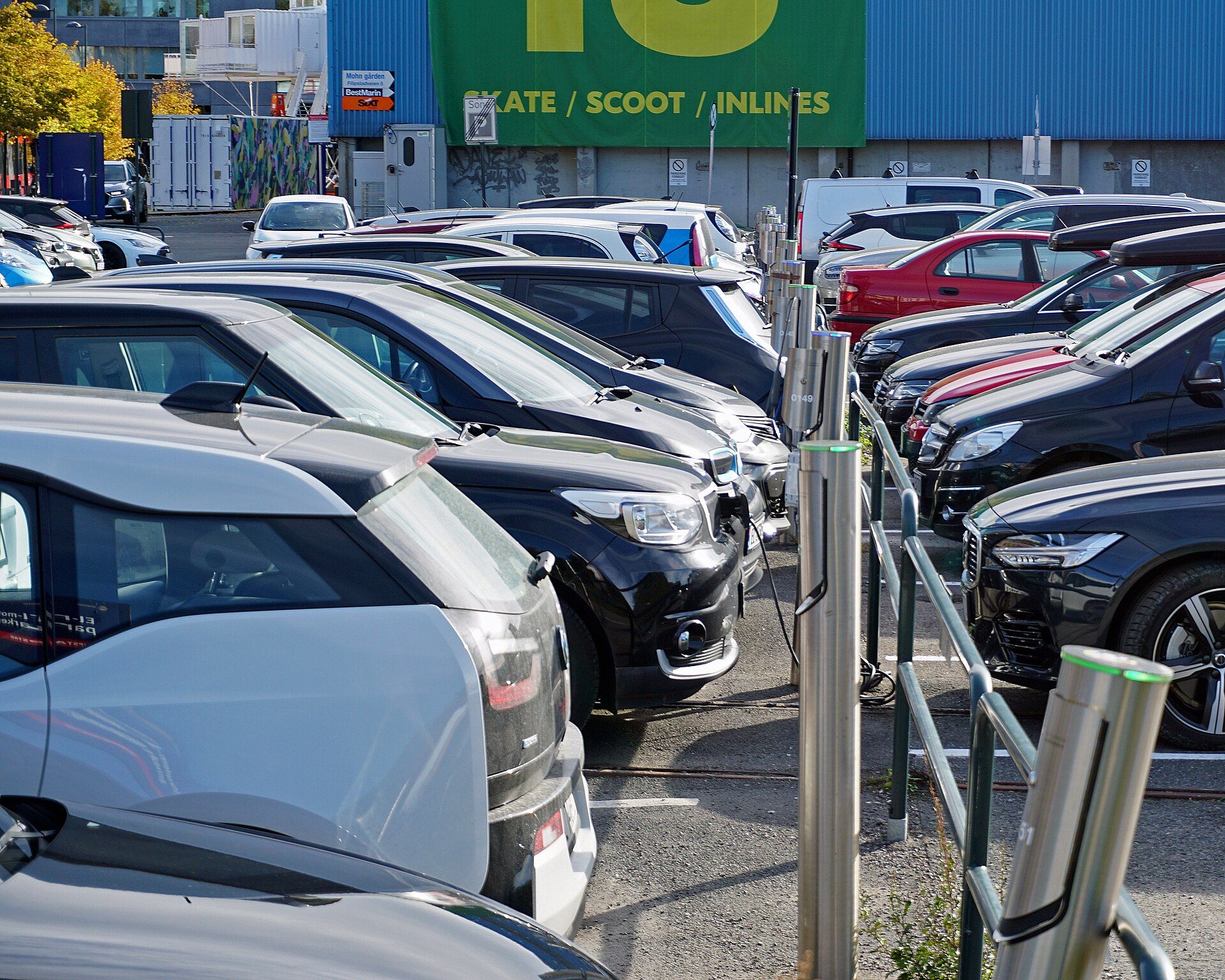
Charged Times compiled this report from the E-Mobility Europe and New AutoMotive October 2026 bulletin and Reuters. The cover photo shows an EV parking lot in Oslo from 2018 and is representative only.
Frequently asked questions
How many electric cars were registered in Europe in October 2026?
295,252 battery electric cars across the 18 markets tracked by E-Mobility Europe and New AutoMotive, 61% more than a year earlier and 32.1% of new registrations.
Which countries bought the most electric cars?
Germany with 94,069 and France with 61,958, which together are more than half of the October total. Norway had the highest share at 98.8%.
Has the EU changed its 2035 car CO2 target?
No. On 4 November a European Parliament committee voted to lower it to an 87.5% cut, but the full Parliament is expected to vote in December and EU governments must agree. The existing 100% target remains in place until then.
Sources
Related stories
Europe's electric car sales jump 61% in October as battery EVs take 32% of the market
Some 295,252 battery-electric cars were registered across 18 European markets in October 2026, taking the year's total past 2.2 million, according to E-Mobility Europe and New AutoMotive.
Updated Zeekr 7X opens for orders in Germany from €54,990, with up to 450 kW charging
Zeekr has opened German orders for the revised 7X electric SUV in three versions priced from €54,990 to €66,990. First deliveries are planned for the first quarter of 2027.

Mercedes-Benz hands its 47 European fast-charging hubs to Electra
All 47 Mercedes-Benz High-Power Charging hubs in Europe, with 374 charge points, joined French operator Electra's network on 1 November 2026. Mercedes drivers get preferred rates at Electra's 800-plus sites.